The Top Health Problems Facing Australian Women in Midlife
You know your body. You also know when you are pushing past the point you should probably slow down. Most women in midlife do, not because they are careless about their health, but because the demands on their time rarely let up. Work, family, ageing parents, a calendar that never seems to have room. Health becomes something to get to later.
The problem is that later is exactly when many of the most serious conditions reveal themselves. And for a significant number of Australian women, they reveal themselves too late.
According to the Australian Institute of Health and Welfare (AIHW), 61% of Australian women are currently living with at least one long-term health condition. Nearly 4 in 10 have two or more. These are not rare, edge-case statistics. They describe the everyday health reality for the majority of women in this country.
For women aged 40 to 65, midlife is not a waiting room for old age. It is a critical window, one where the conditions that will shape the next several decades are already forming. The good news is that 34% of disease burden in women could be prevented by addressing modifiable risk factors. That means awareness, monitoring, and the right support can genuinely change outcomes.
This post walks through the top health issues affecting Australian women in midlife, why so many go undetected for years, and what you can practically do about them.
The Health Conditions Most Affecting Australian Women in Midlife
The picture that emerges from national health data is broader and more interconnected than most women realise. It is not one condition to worry about. It is a cluster of risks that intensify during the midlife years, often quietly, and often simultaneously.
Leading Causes of Death
Australian Bureau of Statistics data show that dementia, including Alzheimer’s disease, has been the leading cause of death for Australian women since 2016. Other major causes include coronary heart disease, stroke, lung cancer, and COPD.
For women aged 45 to 64, the Australian Institute of Health and Welfare reports that breast cancer remains the leading cause of death, which makes regular screening and early detection especially important in midlife.
Disease Burden Across Midlife
Deaths only tell part of the story. Disease burden looks at how many healthy years are lost to illness, disability, or early death, which gives a clearer picture of what affects women through midlife.
For Australian women overall, the biggest contributors to disease burden are:
- Cancer 16%
- Musculoskeletal conditions 16%
- Mental and substance use disorders 12%
- Cardiovascular disease 11%
- Neurological conditions 10%
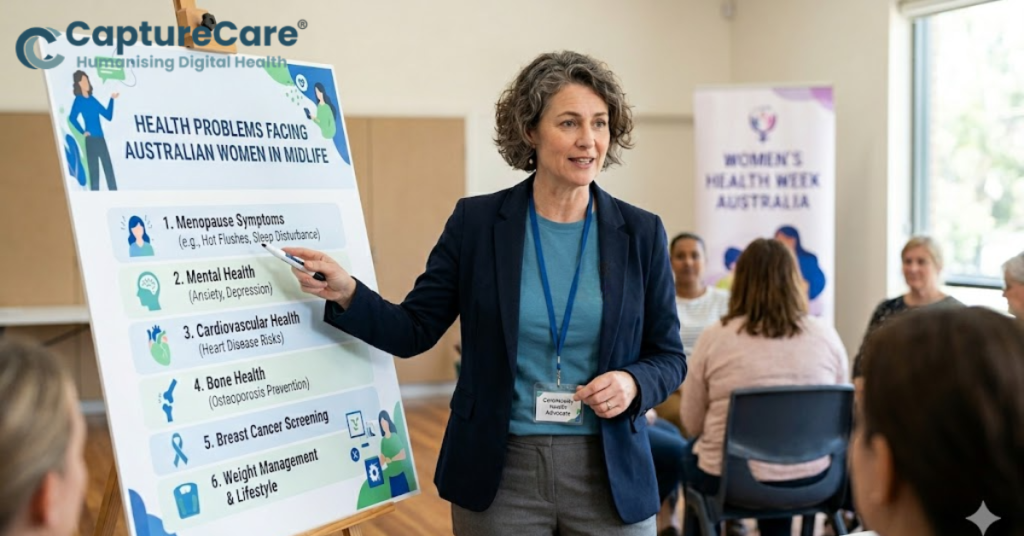
For women aged 45 to 64, musculoskeletal conditions cause the greatest burden, and back pain and problems are the leading specific cause. That matters because pain in midlife does not stay neatly contained to the back. It can affect movement, sleep, confidence, exercise habits, and mental wellbeing over time.
If your body feels stiffer, sorer, or less reliable than it used to, it is worth paying attention early. For more on what often gets overlooked at this stage, see the health changes no one warns you about in midlife.
Why These Conditions Are So Often Missed or Misunderstood
There is a particular cruelty in the way midlife health conditions tend to develop. The ones most likely to cause serious harm are also the ones least likely to give you a clear warning sign.
Symptoms That Blend Into Everyday Life
Cardiovascular disease develops over decades. Bone density loss begins as early as the mid-thirties and accelerates after menopause without a single noticeable symptom until a fracture occurs. Cognitive changes that can signal early neurological shifts are often attributed to sleep deprivation, stress, or simply the pace of modern life.
Mental health is similarly obscured. Anxiety, low mood, and concentration difficulties are common in perimenopause and menopause, yet they are routinely missed or mislabelled as something else entirely. When the physiological basis for these symptoms is not identified, women can spend years managing the wrong problem.
The Menopause Gap
Menopause is at the centre of much of this. The hormonal changes of perimenopause and menopause accelerate cardiovascular risk, drive rapid bone density loss, and contribute to metabolic shifts that increase the risk of type 2 diabetes and weight-related conditions. Most women are not told this.
Research published in the Medical Journal of Australia found that most women are unaware that menopause significantly affects cardiometabolic health and bone density. The same research found that over 85% of women experiencing menopausal symptoms are not receiving effective treatment. This is not a failure of individual women. It reflects a structural gap in how women’s health has been researched, funded, and supported.
The result is that midlife women are often navigating the space between appointments without the information or support they need to understand what is changing in their bodies and why.
The Challenge of Multimorbidity
Nearly 39% of Australian women live with multimorbidity, meaning two or more long-term health conditions at the same time. When conditions overlap and interact, symptoms become harder to interpret. A standard GP appointment, however thorough, captures a snapshot. It cannot always trace the thread between a blood pressure reading that is slightly elevated, a recent increase in fatigue, and changes in sleep quality that have been building for months.
This is where consistent, longitudinal tracking changes the conversation.
What Monitoring and Awareness Can Actually Change
Knowledge of risk is useful. A system for tracking it over time is transformative.
The difference between a condition caught early and one that causes serious harm is often not a matter of how serious it was, but how long it went unnoticed. Cardiovascular disease is the clearest example.
Heart Health and Blood Pressure in Midlife
High blood pressure often has no obvious symptoms, which is exactly why it is easy to miss. Yet it remains one of the most important risk factors for heart attack and stroke. For women in midlife, as cardiovascular risk begins to rise, regular blood pressure checks are not something extra to think about later. They are a basic part of keeping track of your health.
A single elevated reading at a GP visit can be dismissed as situational. A trend showing gradual increases over three months is a different picture entirely. Tracking blood pressure over time gives both you and your GP the context to make informed decisions rather than reactive ones.
The Role of Consistent, Nurse-Led Oversight
This is where having a nurse supporting your health monitoring makes a genuine difference. A nurse who is reviewing your data over time, across weeks and months, is not looking at individual readings in isolation. She is watching for patterns: a shift in resting heart rate, a trend in weight, changes in the metrics that tend to precede more significant health events.
CaptureCare’s approach to preventative monitoring pairs nurse-led oversight with Withings smart health devices that allow women to track blood pressure, heart rate, weight, and other markers from home. The data is reviewed by your nurse, who can flag anything that warrants a closer look and help you prepare for more productive GP conversations. The technology enables consistency. The nurse makes sense of it.
This is not a replacement for your GP or specialist care. It is the structured, attentive support that fills the gap between appointments, the gap where most midlife health changes quietly take hold.
Practical Steps to Take Now
You do not need to change everything at once. What matters is understanding where your health stands and building simple habits that help you catch changes early.
- Know your numbers: Blood pressure, cholesterol, fasting blood glucose, and weight are core markers to track. If you have not checked them recently, ask your GP. A baseline makes change easier to spot.
- Take musculoskeletal symptoms seriously: Back pain, joint stiffness, and reduced movement should not be brushed aside. In midlife, they can point to broader changes in inflammation, strength, and bone health.
- Ask your GP about bone health: Bone loss can speed up around menopause. If you have risk factors or a family history, it is worth discussing bone health and whether a DEXA scan is appropriate.
- Do not dismiss mental health changes: Anxiety, low mood, brain fog, and poor sleep are common in midlife. These symptoms are real and worth discussing alongside physical changes.
- Think about continuity, not just check-ups: One appointment shows one moment. Ongoing monitoring gives you and your care team a clearer view of patterns over time.
It also helps to track changes between appointments. Sleep, mood, energy, pain, and concentration can reveal patterns when viewed together. The aim is not to worry about every symptom. It is to stay informed and act earlier when something shifts.
Your Midlife Health Deserves More Than a Snapshot
Most women do not need more health information. They need better continuity. In midlife, the real challenge is often not motivation. It is having the right support to notice what is changing, make sense of the patterns, and act before small issues turn into bigger ones.
Amelia Dickison, founder of CaptureCare, puts it simply:
“Most of the women I work with are switched on, capable, and genuinely invested in their health. What they are missing is not motivation or access to information. It is a consistent, structured way to stay on top of what is changing before it becomes a problem. A nurse checking in on your patterns over time changes what is possible for your health.”
Midlife is not the start of decline. It is a key window for paying attention, asking better questions, and putting the right support around you.
If you are ready for consistent, nurse-led support that helps you stay across the patterns in your health, find out more about CaptureCare’s PRPM programme or join the waitlist today. Your nurse will be with you every step of the way.

The Author
Amelia Dickison
On a mission to stop the stoppable and prevent the preventable when it comes to our health and happiness
🙌 Start Your Health Journey Today
Whether you’re 40, 60 or 80, stroke doesn’t discriminate — but knowledge gives you the upper hand. The Stroke Risk Test is available right now through CaptureCare, your partner in preventative health and wellness.
💡 Share your results with your GP and start your wellness plan today. Because when it comes to stroke, the best treatment is prevention.