
From Tracking to Clarity: How Midlife Women Can Turn Health Data Into Answers
There’s a particular kind of frustration that many women in midlife know well. You sit in a GP appointment with a list of things that have been quietly shifting your sleep, your energy, the way your heart sometimes races at 2am, and a heaviness that doesn’t quite lift. You try to describe it. The words come out vague. The appointment ends. Nothing changes.
This isn’t a failure of language. It’s a failure of the system to give women the tools to speak in the only dialect that currently gets heard in clinical settings: data.
The Problem With “Off” as a Symptom
Midlife is a period of genuine physiological change. Oestrogen and progesterone fluctuate, then decline. The hypothalamic-pituitary-adrenal axis, the body’s stress-response system, becomes more reactive. Sleep architecture shifts. Cardiovascular risk, once partially buffered by oestrogen, begins to change.
These shifts rarely arrive with a clear label. Instead, they accumulate quietly: a resting heart rate that feels elevated, disrupted sleep with no obvious cause, irregular cycles, or brain fog that feels too vague to bring up at an appointment.
When symptoms are intermittent and hard to articulate, they’re easy to dismiss. A 2025 survey of over 1,000 women found that nearly 40% felt misdiagnosed when seeking care for perimenopause symptoms, with anxiety and depression among the most common incorrect diagnoses given when the underlying cause was hormonal. Fewer than half said their GP had ever raised the topic of perimenopause with them at all.
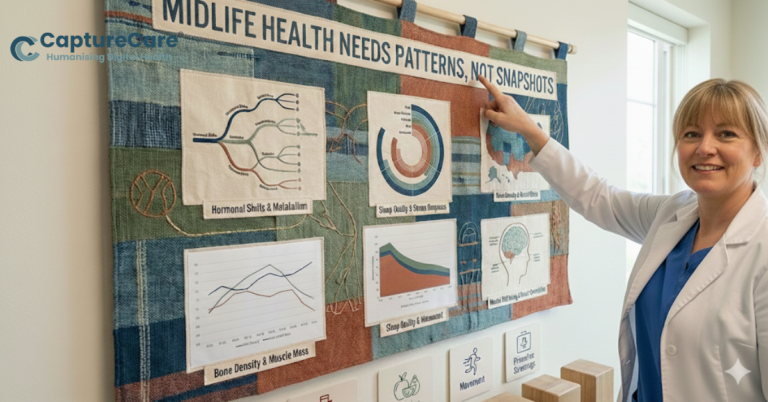
The result is a compounding problem. Without a structured way to record what’s happening, patterns stay invisible. Without patterns, there’s no baseline. And without a baseline, every appointment starts from zero.
Why “Just Track Your Symptoms” Isn’t Enough
The advice to track your symptoms is well-intentioned. But a notes app full of entries like “tired again” or “woke up at 3am, heart was racing” doesn’t translate cleanly into clinical conversation. What midlife women actually need is not more data.
It’s structured data over time, reviewed by someone who knows their individual baseline and can identify when something has meaningfully shifted. Without that structure, unconnected data points tend to produce one of five outcomes at a GP appointment:
- “You’re probably just stressed.” Vague symptoms without documented patterns are easy to attribute to lifestyle rather than physiology.
- “Come back if it gets worse.” Without a baseline on record, there’s no way to demonstrate that things have gotten worse gradually, over months.
- “Your results are within the normal range.” A single test snapshot misses the fluctuations that only become visible across time.
- “Have you considered anxiety?” Symptoms like disrupted sleep, elevated heart rate, and low energy are frequently redirected towards mental health diagnoses when hormonal context is absent.
- “There’s not much we can do right now.” Without trend data to act on, clinicians have limited grounds to investigate further or refer.
The gap is real enough that the Australian Government has formally acknowledged a “low level of awareness and understanding of menopause” even within the medical community, which helps explain why so many women leave appointments feeling unheard rather than informed. When you can’t clearly articulate what’s changing, the risk of misdiagnosis rises, not because your clinician isn’t trying, but because the clinical picture is incomplete
Data as Agency, Not Anxiety
For many midlife women, “tracking” sounds like anxiety with extra steps. Done well, it’s the opposite; it replaces guesswork with clarity.
Tracking Is Not the Same as Worrying
There’s a distinction worth making here. Tracking your health metrics is not the same as monitoring yourself into anxiety. Done well, health baseline tracking creates a foundation of calm, not panic, because when something does shift, you and your care team can see it in context, not in isolation.
Your Data Becomes Your Evidence
Australia’s leading non-profit women’s health organisation, Jean Hailes for Women’s Health, provides a dedicated perimenopause and menopause symptom checklist for exactly this reason: so you can record what you’re experiencing and bring something concrete to your next appointment.
When you have a documented baseline of your normal resting heart rate, your typical sleep patterns, and your cycle length over twelve months, you no longer have to rely on memory or estimation. You have evidence
When Symptoms Become Clinical, They’re Harder to Dismiss
This shift matters for more than diagnostic accuracy. It matters for the stigma that still surrounds midlife health. The same report found that 82% of perimenopausal and menopausal women reported stigma associated with their symptoms, a figure that helps explain why so many women minimise what they’re experiencing before they ever reach a clinician.
When symptoms are reduced to data points and trends, they become harder to dismiss. They become clinical, not personal. They become something that can be investigated, not reassured away.
What Consistent, Nurse-Led Monitoring Actually Looks Like
The barrier for most midlife women isn’t access to information. It’s access to a consistent clinician who knows their history and can review their data regularly. A single GP appointment every three to six months, with no structured data in between, means that patterns typically escalate before they become visible.
CaptureCare was built to close that gap. It’s a nurse-led health monitoring service for midlife women, designed around the idea that continuity of care changes what’s possible. This is especially true when a clinician is watching the pattern, not the moment.
Here is what that looks like in practice:
- Daily nurse review: A registered nurse monitors your health metrics every day, not weekly summaries or automated alerts, but a real clinician reviewing your data with your individual baseline in mind.
- Longitudinal tracking with Withings: Clinical-grade wearable technology from Withings captures the data that makes patterns visible over weeks and months, not just on the day of an appointment.
- A clinician who knows your history: Because the same nurse reviews your data consistently, shifts are noticed in context rather than in isolation.
- Preparation for GP appointments: When you arrive at your next appointment, you bring a documented picture of what has changed and when, not a description from memory.
- Confidence to advocate for yourself: Having evidence behind you changes the conversation entirely.
“What I see with the women I support is that they often already know something has changed,” says Amelia, a registered nurse with CaptureCare. “They just don’t have the language or the records to back it up. When we can show them their data, something shifts. They stop second-guessing themselves. They come to their GP appointments with something concrete.”
Practical Steps You Can Take Now
While you’re waiting for a more structured monitoring model to be available to you, there are things that will make a material difference to the quality of care you receive. None of these require a device or an app. They require consistency and specificity, two things that turn a vague symptom into a clinical observation.
- Keep a dated symptom record: Not a journal, a log. Date, time, what you noticed, and any relevant context. Specificity is what makes symptoms clinical.
- Track at least one objective metric consistently: Resting heart rate, sleep duration, or blood pressure recorded at the same time each day gives you a baseline. One month of consistent data is more useful than six months of intermittent readings.
- Request copies of your test results: You are entitled to them. Knowing your own reference ranges means you can notice when something shifts, even within normal limits.
- Prepare for appointments with a timeline: Instead of describing symptoms in general terms, bring three to five specific dated examples. A clinical observation is precise. “I haven’t been sleeping well” is not.
- Name the pattern, not just the symptom: If your energy drops in the week before your period, or your sleep worsens during high-stress periods, say that explicitly. Patterns are what clinicians can act on.
These steps won’t replace consistent clinical oversight, but they will make every appointment more productive and every conversation with your care team more informed.
A Different Kind of Support
Midlife health doesn’t have to be managed in between appointments, on your own, with incomplete information. The tools to build a real clinical picture of what’s happening in your body exist. What’s been missing is a care model that uses them consistently, with a qualified clinician who knows your history.
If you’re in midlife and you’ve been wondering whether what you’re experiencing is worth investigating, it is. Your symptoms are not vague. They may simply not yet have the data behind them to be seen clearly.To learn more about how CaptureCare supports midlife women with nurse-led, continuous health monitoring, join the waitlist today.

The Author
Amelia Dickison
On a mission to stop the stoppable and prevent the preventable when it comes to our health and happiness
🙌 Start Your Health Journey Today
Whether you’re 40, 60 or 80, stroke doesn’t discriminate — but knowledge gives you the upper hand. The Stroke Risk Test is available right now through CaptureCare, your partner in preventative health and wellness.
💡 Share your results with your GP and start your wellness plan today. Because when it comes to stroke, the best treatment is prevention.