Why Sleep Might Be the Most Underrated Health Metric for Women Over 40
Many women in their 40s and 50s say they have not slept properly in years, then carry on as though it is normal. Poor sleep often gets pushed aside at GP appointments or explained away as stress, a busy life stage, or simply getting older.
But sleep disruption in midlife is more than an inconvenience. For women in perimenopause and menopause, it is one of the most common symptoms of hormonal change, yet one of the most easily overlooked. When sleep starts to break down, it can affect far more than how tired you feel the next day.
Poor sleep has been linked to cardiovascular risk, weight gain, insulin resistance, cognitive decline, and mental health challenges. Even so, many women continue to normalise it. They put it down to work, parenting, or just how they are. But in midlife, broken sleep is often a health signal, and it deserves to be taken seriously.
What Happens to Sleep During Perimenopause and Menopause
Sleep is not just downtime. Across the night, your body moves through different sleep stages that support physical repair, memory, immune function, and emotional regulation. When those stages are disrupted night after night, the effects can show up across many areas of health.
During perimenopause and menopause, changing oestrogen and progesterone levels can affect how easily you fall asleep and stay asleep and how rested you feel the next day. The Australasian Menopause Society notes that disrupted sleep is common during this stage, with hormonal changes, hot flushes, and night sweats all playing a role. Jean Hailes also lists sleep disturbance as one of the most common menopause-related concerns.
What makes midlife sleep problems harder to untangle is that they are rarely caused by one thing alone. Night sweats can wake you suddenly. Anxiety and stress can make it harder to get back to sleep. Other issues, including changes to your body clock, snoring, or sleep apnoea, can add another layer. Over time, these broken nights can affect energy, mood, mental clarity, and overall wellbeing.
This is why sleep in midlife should not be brushed off as just part of getting older. Poor sleep can influence day-to-day functioning, and Better Health Channel notes that menopause-related symptoms often include sleep problems, tiredness, anxiety, and brain fog. It is a pattern worth paying attention to, especially when it starts to become your new normal.
Why Sleep Disruption in Midlife Women Gets Missed
For many women, sleep disruption builds slowly. It shows up as broken nights, early waking, lower energy, and feeling off without a clear reason. Because the signs are subtle and often brushed off as stress, ageing, or a busy life stage, the bigger health pattern can go unnoticed for far too long.
Many women explain it away
There is a quiet but familiar pattern in how midlife women talk about sleep. I’ve always been a light sleeper. It’s just stress. I’m a mum; of course I don’t sleep well. These explanations are not necessarily wrong, but they can stop women from seeing sleep disruption as part of a bigger health picture. They can also make it less likely that sleep comes up as a real clinical concern.
The signs are often subtle
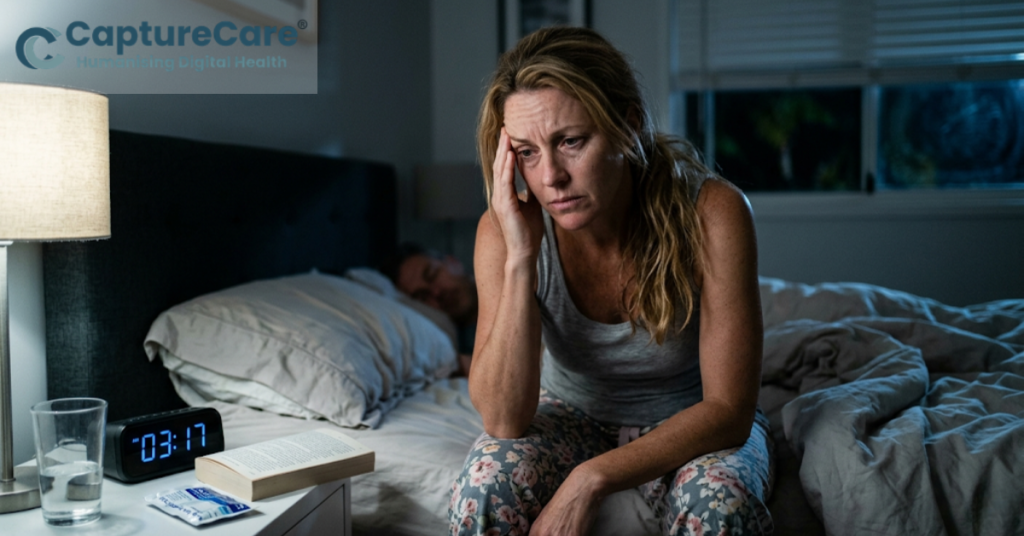
Poor sleep in midlife does not always look dramatic. Many women are not awake for hours every night. Instead, they wake at 2 or 3 am and struggle to get back to sleep. They sleep for seven or eight hours but still wake feeling flat. Their energy drops slowly over time, and they cannot always explain why.
That is part of what makes this so easy to miss. These are not always obvious warning signs. They are patterns, and patterns are easy to normalise when there is no clear baseline to compare them to.
Normal results do not always tell the full story
There is also a clinical gap. Sleep disruption linked to perimenopause is often underreported and underexplored. A woman may mention fatigue at a GP appointment, have blood test results come back within range, and still leave without clear answers.
As discussed in why normal results don’t always mean you feel normal, a single test in isolation does not always capture what the body has been experiencing over time. When sleep is looked at on its own, or not tracked at all, the broader pattern can be missed.
The wider health pattern can stay hidden
Without consistent tracking, it is easy to miss the connection between poor sleep and other changes, such as rising blood pressure, shifts in mood, weight changes, or declining energy. When each symptom is looked at separately, the overall story can stay invisible.
The AIHW Australian Burden of Disease Study identifies sleep disorders as a meaningful contributor to health burden in Australia. Even so, sleep remains one of the most overlooked parts of midlife women’s health, both in clinical care and in the way women are taught to think about their own wellbeing.
Sleep as a Vital Sign, Not a Lifestyle Factor
What if sleep were tracked as consistently as blood pressure, not as a vague wellbeing question, but as a meaningful health metric over time?
That is what remote monitoring now makes possible. Tools like Sleep Analyser can collect overnight data on heart rate, breathing, movement, snoring, and signs of sleep apnoea without requiring anything to be worn or charged. The real value, though, is not the device itself. It is the pattern the data reveals over time.
A gradual drop in sleep quality alongside rising blood pressure or declining energy tells a very different story than any one result on its own. At CaptureCare, registered nurses look at sleep alongside other markers such as weight, mood, and blood pressure to spot trends that may need closer attention or clinical follow-up. As explained in what it means to have a nurse watching the pattern, not the moment, this kind of ongoing monitoring offers a fuller view than the occasional snapshot most women get through standard care.
It also gives women something important: clear evidence. Being able to show a health professional months of disrupted sleep data can shift the conversation from ‘I’ve been feeling off’ to ‘Here is what my body has been doing.’ For many midlife women, that can make all the difference.
What to Watch For and What You Can Do
Sleep problems in midlife are easy to brush aside, especially when they build slowly. Paying attention to recurring patterns and taking a few practical steps early can help you understand whether poor sleep is simply occasional disruption or a sign that your body needs closer support.
Signs Your Sleep May Be a Health Signal Worth Tracking
Not all sleep disruption is hormonal, and not all of it requires immediate intervention. But certain patterns are worth paying attention to, particularly in your 40s and 50s.
- Regularly waking between 2 and 4 am without an obvious cause
- Feeling unrested despite sleeping for seven hours or more
- Night sweats that interrupt your sleep cycle
- A gradual, unexplained decline in energy or mental clarity
- Increased anxiety or irritability that feels linked to how you are sleeping
- Snoring, or being told you stop breathing during sleep
On their own, these signs may seem easy to dismiss. Together, and over time, they can point to a pattern that deserves closer attention.
Practical Steps to Take
If any of these sleep patterns sound familiar, there are practical steps you can take now. The goal is not to react to one difficult night, but to build a clearer picture of what has been changing over time.
- Start tracking your sleep consistently: Even a simple note of when you fell asleep, when you woke, and any disruptions during the night can be useful. Over four to six weeks, this can help you spot patterns linked to your cycle, stress, alcohol, travel, or other daily factors.
- Speak to your GP about sleep in the context of perimenopause: Explain how long the disruption has been happening, how it is affecting your day-to-day life, and whether it lines up with symptoms such as night sweats, mood changes, or fatigue. This can help shift the conversation beyond stress alone.
- Consider continuous monitoring: As explored in blood pressure monitoring for midlife women, looking at health metrics over time gives a far more complete picture than any one result on its own. Sleep is not a small part of that picture. It is a meaningful one.
- Do not wait until you feel completely unwell: Sleep decline is often gradual, which is why it gets normalised so easily. Paying attention early is usually far easier than trying to address a more established pattern later on.
You do not need to solve everything at once. What matters most is noticing the pattern, taking it seriously, and giving yourself the support to act on it early.
Sleep Is a Vital Sign. It Deserves to Be Treated Like One
For too long, poor sleep has been treated as a side effect of a busy life or something women simply need to push through. But in perimenopause and menopause, sleep disruption is often tied to hormonal change and can affect cardiovascular health, metabolic function, mood, and overall wellbeing.
Looking at sleep patterns over time, and viewing them alongside other health markers, is not a wellness extra. It is a practical way to understand what your body may be signalling before problems build further.
Amelia Dickison, founder of CaptureCare, puts it simply:
“Sleep is one of the first things women tell us has changed. It is also often the thing they stop mentioning, because they assume it is just part of this stage of life or that nothing can really be done. But when our nurses can see sleep alongside blood pressure, weight, energy, and mood, it becomes part of the bigger health picture, not just a side note.”
If you are ready to stop guessing and start understanding your health patterns, join the waitlist today. Our registered nurses are here to help you make sense of what your body is telling you before it needs to shout.

The Author
Amelia Dickison
On a mission to stop the stoppable and prevent the preventable when it comes to our health and happiness
🙌 Start Your Health Journey Today
Whether you’re 40, 60 or 80, stroke doesn’t discriminate — but knowledge gives you the upper hand. The Stroke Risk Test is available right now through CaptureCare, your partner in preventative health and wellness.
💡 Share your results with your GP and start your wellness plan today. Because when it comes to stroke, the best treatment is prevention.